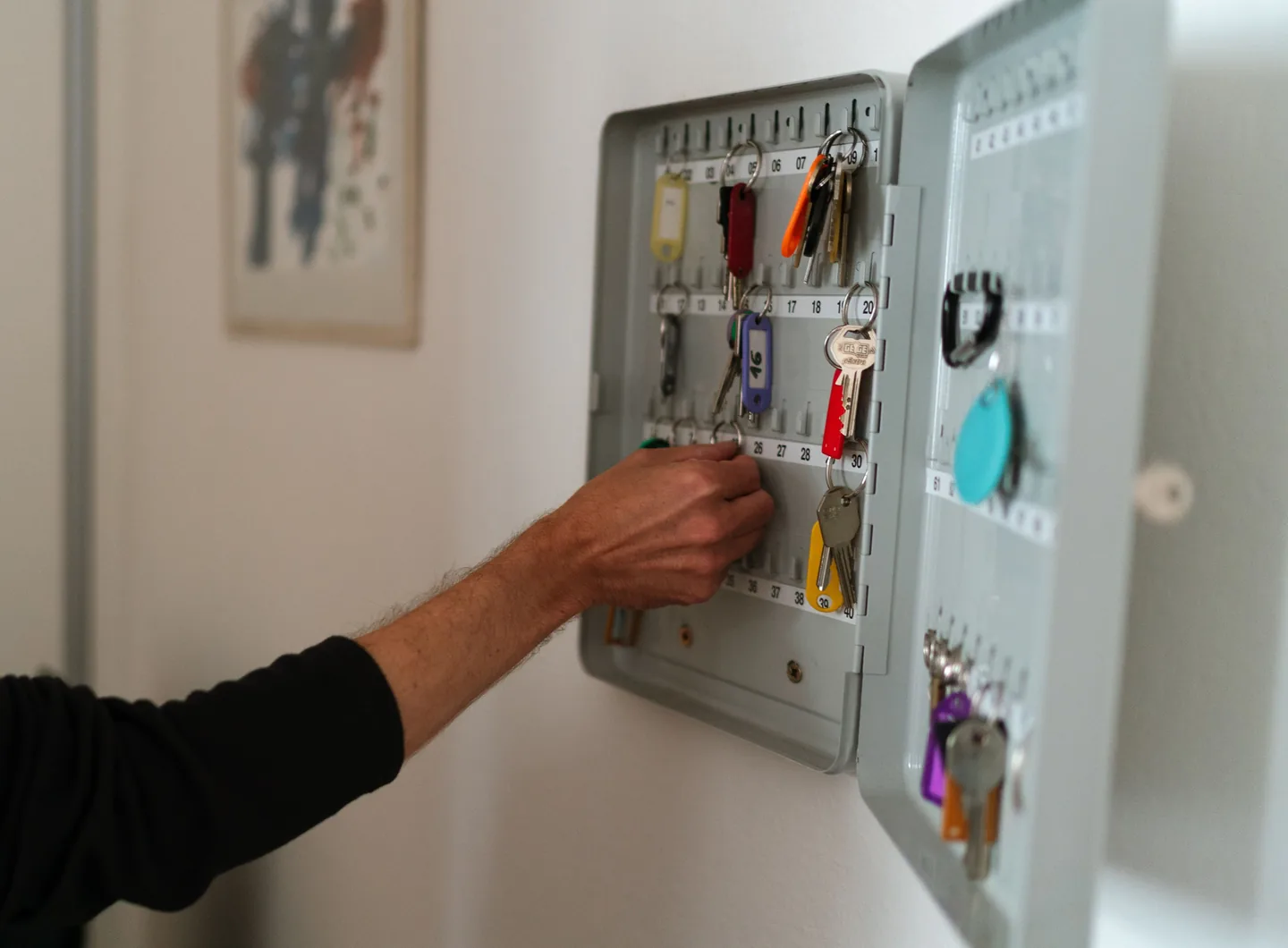
The first part of this series covered assisted-living alarm services — there, keys stay in storage and only travel during a call-out. Home care is the opposite case: here the keys are constantly on the move. Every round starts at the key rack of the care station and ends there again — ideally. In between lie eight to fifteen client homes, a company car, a shift change and the occasional last-minute change of route because a colleague has called in sick.
14 home care services and community care stations manage their client keys with Log+Key today — from the small station with 50 keys to the charitable provider with several hundred. This is what they have taught us about key processes in care. Six lessons, as always without the gloss.
Lesson 1: in home care, keys travel — from hand to hand
What is the exception in alarm services is the normal case in care: keys change hands. The morning round hands over to the late round, the planned route gets rearranged, a stand-in steps in — and Mrs M.'s front-door key travels along. Every one of these handovers is a potential gap in the documentation, because it rarely happens at the key rack and almost never with the key book within reach.
The consequence for the process: a handover has to be documentable where it happens — in the car park, in the company car, between two visits. On a smartphone, in seconds. Anything else simply does not get done in the daily rhythm of the rounds.
Lesson 2: the real emergency is not loss, it is "who has it right now?"
Client keys are rarely lost outright. Far more common is the state in between: the key is not gone, but nobody knows off-hand who is carrying it. The care service manager turns into a switchboard, three colleagues get called after hours, and meanwhile the stand-in is standing in front of a locked front door — behind which a person in need of care is waiting.
For almost all of our care customers, precisely this moment was the trigger to tackle the topic: not a loss, but the recurring search. A live overview of who is carrying which key ends it for good.
Lesson 3: staff turnover is a key process
Care has high staff turnover — that is not news. What is surprisingly often missing is the second look at what it means: every departure is also a key return. When an employee leaves the service, it has to be clear which keys they are carrying — on their last working day, not three weeks later when someone clears out the locker.
Without a system, that means reminders, chasing and hoping. With a system it is one click — the overview of all open checkouts per person is one of the most-used functions among our care customers. It turns an awkward offboarding conversation into a checklist.
Lesson 4: a lost key costs more than a cylinder
If a key does go missing, replacing the cylinder is the smallest problem — and in case of doubt the care service is left with the bill. What costs more is what cannot be measured in euros: the conversation with the client and her relatives, who entrusted you with the key to her home. In home care, trust is the real capital.
That is why the key process also includes cover for the worst case: a complete history showing that everything was handled properly — and narrowing down where the key last was. The PQSG recommendation on handling front-door keys (German) frames this as a quality criterion; how the documentation helps in audits by the medical review board is something we have described in detail here.
Lesson 5: the care service manager does not need an IT project
Our care customers are organised differently from the large alarm service associations in part 1: smaller teams, shorter decision paths, no IT department. A care service manager who wants to solve a key problem has neither the time nor the budget for an implementation project — and, honestly, no appetite for one either.
That has shaped our product: getting started has to work without a training day. Tags on the keyrings, a scan before and after the round, done. At Caritas Krefeld this rhythm has become so established that missing keys stand out immediately — covered in "Caritas in NRW". And on request we handle the initial import of your key inventory, so the start does not fail at the legwork.
Lesson 6: digitalisation in care is subsidised — including this
Perhaps the least-known lesson: the care service does not necessarily have to pay for digitalising its key management alone. Depending on the federal state, there are funding programmes for digitalisation projects in care — in Lower Saxony, for instance, with up to €40,000. We have summarised what is funded there and how the application works. It is worth a look at your own state's programmes before purchasing.
What this means for your care service
If you run a community care station or a home care service, the six lessons make a usable self-check:
- Can a key handover be documented where it happens?
- Do you know who is carrying which key without making phone calls?
- Is staff turnover managed as a key process?
- Would your documentation stand up to an audit?
Everything else can be found on our page about key management for home care. If you would rather talk through your own routines directly: we offer a free initial consultation — we know the processes, the decision is yours.
Next in the series: property management — contractors, tenant changes, and the question of why the Excel spreadsheet survives longest there of all places. Running an alarm service alongside your care operation? Then it is worth looking back at part 1.