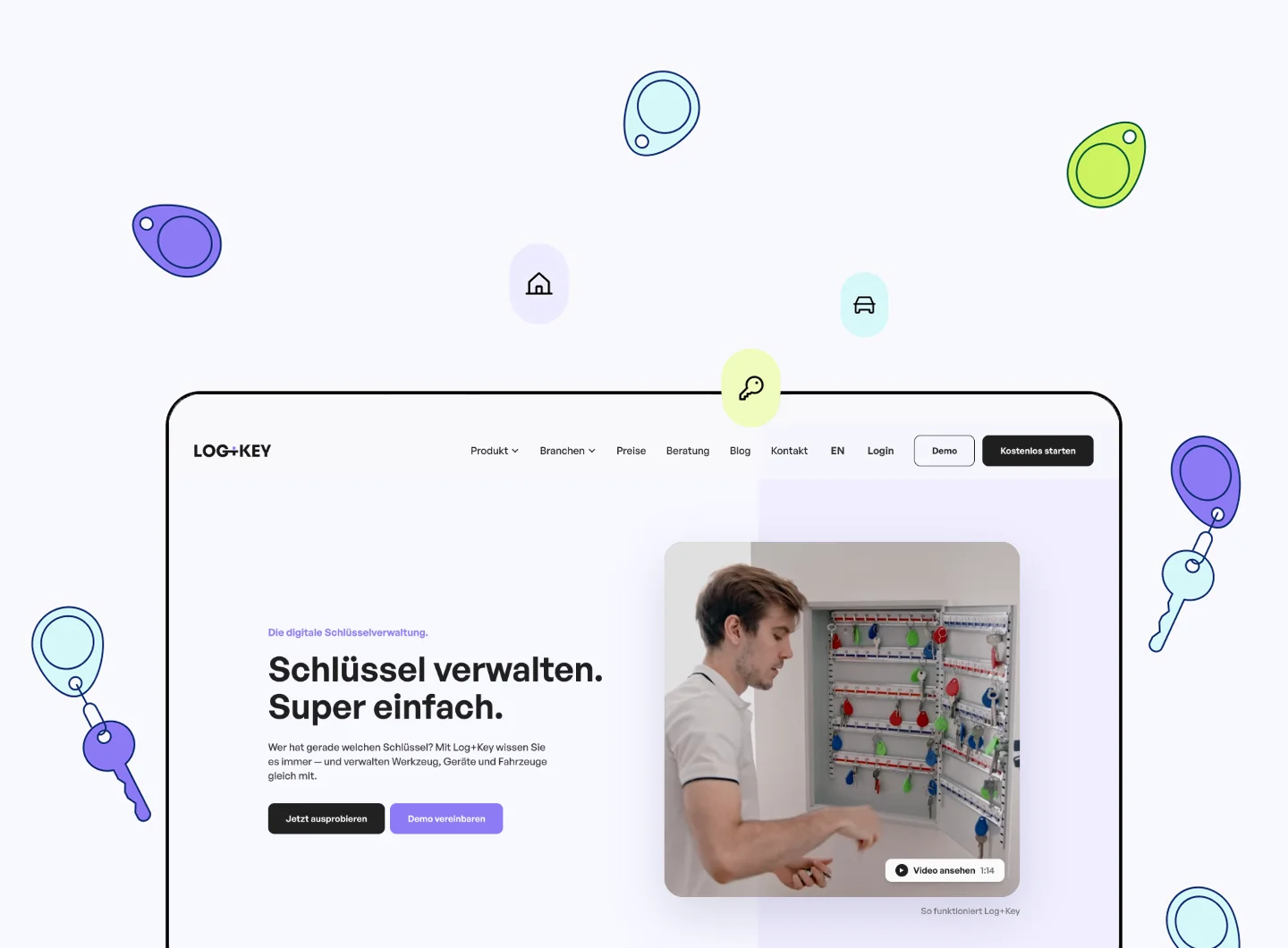
An admission first: this website — the page you are reading this article on — was largely built by artificial intelligence. The code behind the blog, the landing pages, many first drafts of the copy: AI work, directed and reviewed by a team of designers, editors and developers.
And a second admission straight after: for Log+Key itself — the software you entrust your key data to — different rules apply.
Why we draw that distinction is not a side issue. It is one of the questions organisations now regularly put to us during selection processes, and it deserves a fuller answer than one sentence in an annex to the contract.
Not all software carries the same risk
If a paragraph on our website is badly formatted, that is embarrassing. If a key history in Log+Key were wrong, that is a real problem for you: your documentation towards funding bodies, clients and auditors depends on it. Key documentation tolerates no vagueness — for us that is not a slogan but the standard by which we choose our tools.
So before asking "can AI do this?", we sort every task by a different question: what happens if it goes wrong — and how quickly would we notice?
A marketing website is a forgiving case in that respect: mistakes are visible, have no consequences for customer data, and are fixed in minutes. The website also has no access whatsoever to Log+Key systems or customer data — it is completely separate technically. Under those conditions AI is an excellent tool: fast, thorough, and the result can be checked by anyone on the team before publication.
The core software is the opposite case: mistakes would be silent, consequential, and might only surface during an audit. So a different process applies there.
How a feature in Log+Key comes about
Every function in Log+Key — from the audit log to the PDF receipt — takes the same route: it is designed by people who know how our customers work, often together with the customer who prompted it. It is implemented and reviewed by our developers before it reaches you.
What "reviewed" means here is a fixed sequence that every change goes through:
- Development: Every new feature is built on its own branch and first tested locally by the developer responsible for it.
- Staging review: Once it is declared ready, it is deployed to a staging environment and reviewed by our product owner: does it deliver the functionality that was planned? For features commissioned by a customer, the question also covers whether it meets the agreed requirements.
- Release candidate: Only once the review has been passed is the feature merged into the release candidate for the next version of Log+Key.
- Test run: Every new release is tested thoroughly by human testers against a detailed checklist — the new features and the entire standard feature set, so that no unforeseen side effects slip through.
- Release: Once all tests come out green, the new version of Log+Key is released.
AI certainly plays a part — as a tool in our developers' hands, much like a good editor or a testing tool. What it does not do here is put functionality into the software on its own. Not a line goes into production that no human has reviewed and taken responsibility for. Responsibility cannot be delegated to a language model — least of all in software that carries your compliance.
Why we are telling you this at all
You could call this article risky: why admit that AI builds the website? Because the alternative — not saying so — suits us less well. Clarity and reliability are not top of our list of values by accident. And because we believe the question "where do you use AI?" will belong in every proper software selection in the years ahead — rightly so.
You are welcome to reuse our answer, including as a test question for other providers: not "do you use AI?" — almost everyone does by now — but "where exactly, where not, and who is responsible for what reaches the customer?" Anyone without a clear answer to that has probably not done the sorting by risk.
What this means for your data
For you as a customer or prospect, the difference comes down to this: on the website we experiment — AI helps us produce what should make your decision easier, faster and better. In the software we conserve — nothing changes there without human review, because your key history is built on being correct.
You will find more on hosting, access control and data protection in Log+Key on our security page. And if you have questions it does not answer — including the critical ones, especially the critical ones: get in touch. We would rather answer at length before the contract than evasively afterwards.